ARCHITECTURE MONOGRAPHS

Steven Holl
The Body In Space

Steven Holl The Body in Space opens with the architect describing what he considers the "urgent mission" of his work:

We have all experienced inspiring conditions in nature where the light, the moonlight on the snow glows and one walks through a landscape and feels uplifted and euphoric over this condition of space and light and movement and textures. I think that architecture really is the one art that has the opportunity to add this to our daily lives…I see it as an urgent mission on this level.

The feeling that one has when one encounters a building or architectural structure Holl refers to the phenomenological experience. To him phenomenology is the study of essences, and architecture is the one discipline that is capable of evoking essences in our daily lives. As a sensory architect, Holl believes that our experience of architecture is visual, but it is also tactile, aural, olfactory and intertwined with space and the body trajectory in time. The architect must consider the project on all of these levels.

Watercolor studies are very important to Holl in the working out of ideas; of capturing the feeling of the space that he is designing; or as a means of experimenting with light sources and materials. He often starts his day with a meditation watercolor of his first intuitive thoughts - his moment of calm before the chaos of his office. Often he listens to Gregorian chants during these moments.

This film begins with a visit to the celebrated KIASMA, or Museum of Contemporary Art in Helsinki which we follow from ground-breaking through completion. Interviews are conducted with Tuula Arkio, the Director of the Museum; Juhani Pallasmaa, associate architect, and others involved with the project. When Holl was awarded this commission he competed with over 500 other designers. The building is designed to make the most out of the limited height of Helsinki's sun - which never gets above 51 degrees. In answer to this problem, Holl created a wall of ice to bring in light. This wall starts at 9 1/2 degrees, goes through the length of the building and ends at 9 1/2 degrees. In this way the light is brought in horizontally. The 25 galleries of the Museum offer 25 different kinds of light. Holl based his decisions regarding the design upon how each would be experienced, rather than on abstract concepts. This sensory realist approach was celebrated by the inhabitants of Helsinki as being similar to that of Alvar Aalto.

Holl's belief in the tactile experience of light, space and material are explored in his Chapel of Saint Ignatius at Seattle University. Although he is not Jesuit or Catholic, Holl's belief in the "religiosity of architecture" helped him to convey a sense of the sublime in the Chapel. Prior to designing the space he immersed himself in the writing of Saint Ignatius, and was surprised to find a kindred spirit who had progressive ideas about the senses - which he reorders in such a way that smell and touch carry more importance than sight.

Holl speaks of the "enmeshed experience" in which space, light, color, geometry, detail and material are intertwined. He compares this to sitting in a room by a window - the view, the light from the window, objects on the floor, the material on the desk and what one holds in one's hand all begin to merge. This convergence is what he calls intertwining space.1 With the Storefront for Art and Architecture which he designed with artist Vito Acconci, the object was to create a structure that was enmeshed with the surrounding cityscape. The façade walls of the building pivot and become tables where visitors can sit, relax, and communicate. The gallery is turned inside out, and both the outside and the inside are reconstructed.

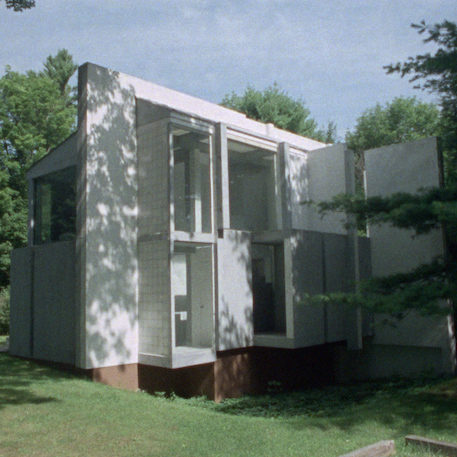
Intertwining is the criss-crossing of the tangible and the abstract thought (or concept). Holl: "For me architecture revolves around the experiential phenomena, the way we really feel the space, the light and the material, but that experiential phenomena must be driven by a concept, a thread which holds all the manifold parts of a project together." In this way ideas are turned into buildings. With his Martha's Vineyard House, Holl had read Moby Dick, and Melville's description of how the Indians of the Island transformed the skeleton of a whale into a sort of house-frame by stretching bark over it. He was influenced by this idea when designing the house, which also resembles a whale. "What I think is important is that the conceptual structure is always different depending on the site, the situation and the program."

The architectural process for Holl's begins with a visit to the site, which is important for practical reasons, as well as to consider the intertwining of the structure and the landscape. He then goes back to the studio where he does watercolors of his ideas. The watercolors serve as the beginnings of the conceptual design for the building. Next plaster models are made to add another dimension. After this, the watercolors are scanned into the computer so that plans can be developed.

Another concern of Holl's is parallax, or the movement of body in space. He believes that the architect must consider "what's around the corner" - the perspectival space. In the film Holl takes us to see Richard's Serra's Torqued Elipses, and demonstrates that as one moves through the sculpture one has different sensations based on movement, light, and visual and tactile variations.

The last project explored in the film is the Makuhari, Japan housing project of 200 apartment units, which was built upon mud dredged from Tokyo Bay. He was inspired by the idea of the Japanese pavilion. He developed a concept called "inner journey" with lightweight pavilions as activist structures in combination with silent heavyweight blocks, which form the structure of the housing block. Each apartment has a view of a water garden, and sections of the structure are tilted to reflect light and color for the residents.

In considering future projects, Holl expressed: "My hope in developing our next architectures is that we will remain experimental and open to new ideas and really open to the site and circumstance and fusing all of these factors to find new architectures for the future." Current projects include new facilities for the College of Architecture, Cornell University; a new central wing for the School of Architecture at Pratt Institute; an expansion and renovation of the Nelson-Atkins Museum of Art in Kansas City and an historical museum for writer Knut Hamsun in Hamarøy, Norway.

1. Holl, Steven. "Intertwining", Intertwining - Steven Holl Selected Projects, Princeton Architectural Press, 1996.